Fourth virtual club night

Warm-up

We’re going to use a warm-up that UK SCD teacher Mervyn Short used for the RSCDS online “Dance Scottish at Home” class last week. Mervyn took my class at the Cambridge Summer School, he is a wonderful teacher and it is a bit of a bonus to be able to have his teaching again so soon. The Dance Scottish at Home classes are live every week at 6:00AM NZ time and a recording of them is made available by Saturday (NZ time). The teacher each week is a surprise. The class recordings can be found here Dance Scottish at Home Classes Mervyn’s class is the one on 15th April, the warm-up starts at about 12 minutes 30 secs into the recording if you want to skip the hellos and getting things sorted at the beginning.

Bar 1 to 4 – March on spot for 4 bars (8 steps, 4 each leg – obviously alternate each leg!)

Bar 5 to 8 – Forward R and L, back R and L, repeat

Bar 9 to 12 – Step to side –R together, R together, L together, L together

Bar 13 to 16 – Single side steps R together L together, R together L together

Bar 17 to 24 Forward R, L, R then point L heel to floor; back L,R,L then point R heel to floor, Repeat.

Bar 25 to 32 4 Pas de basque (just movement, no impact or lift) then skip change of step forward for 2 and back for 2 (again no elevation and impact)

Go through this 4 times, being more energetic and taking longer steps each time and adding arms.

This will be best done with some music, since you may not have much of a SCD music collection here is a link to a suitable two-step, ignore the video and the general hubbub of chat (if the musicians are playing it is for a reason and that is to dance)

https://youtu.be/8KkoExPh9H4?t=37

Dance

Tarry a While (RSCDS 1st Graded Book)

A simple dance that you can dance on your own (or with whoever is in your bubble) with “ghosts” making up the missing dancers. Make sure that hands are at the right height (the ghosts will not be able to help you – you have to support the weight of your own hand), that you make eye contact and smile at the ghosts and make the pousette a crisp square shape with good 90 degree corners. Here is a link to a video of the dance being done well in a small living room Tarry a while

The Dance instructions:

Bars 1 to 8 1st Man and 2nd Lady turn R hand and then L hand

Bars 9 to 16 1st Lady and 2nd Man turn R hand and then L hand but for 1 1/4 times to end in diagonal line taking R hand with their partner

Bars 17 to 20 Balance-in-line – setting twice

Bars 21 to 24 1st Lady and 2nd man turn 3/4 meeting their partners (who step in) ready for:

Bars 25 to 32 Pousette

And the diagram:

Dance the dance through twice, make sure that you are standing ready to dance when you need to come in – in this dance everyone has bars of dancing and standing so listen carefully to the music and be ready.
Programme for Wednesday 15th April

Third virtual club night

Warm-up Amazing Grace (again).

Dance. Domino Five. Here’s a video (it’s not a demonstration but it has the great merits that the dancers look as though they are enjoying themselves and the set is the right way round – a couple of demo videos have the set upside down) Domino Five

Here’s the diagram:

And instructions:

Bars 1 to 4        Dancers 1+2+5 dance right hands across

Bars 5 to 8        Dancers 3+4+5 dance left hands across

Bars 9 to 16     Dancers 1+3+3 dance a right shoulder reel of 3 (5 and 1 pass right shoulder to begin)

Bars 17 to 24   Dancers 4+5+2 dance a left shoulder reel of 3 (5 and 4 pass left shoulder to begin)

Bars 25 to 28   Dancers 1+5 change places passing right shoulder, dancers 4+1 change places passing right shoulder

Bars 29 to 32   Dancers 3+4 change places passing right shoulder, dancers 2+3 change places passing right shoulder

Points:

  • Each formation flows smoothly into the next, dancer 5 is passing through their starting place every 4 bars until bar 24
  • Dancer 4 needs to watch the reel in bars 9 to 16 carefully so as to not try to start their reel before bar 17 (often dancer 4 sees dancer 5 coming towards them on bar 12 (half way through the right shoulder reel) and mistakes it for the end of bar 16). At the same time dancer 5 should try to avoid catching dancer 4’s eye.
  • The change places in bars 25 to 32 are quiet slow and should be graceful arcs passing through the central position

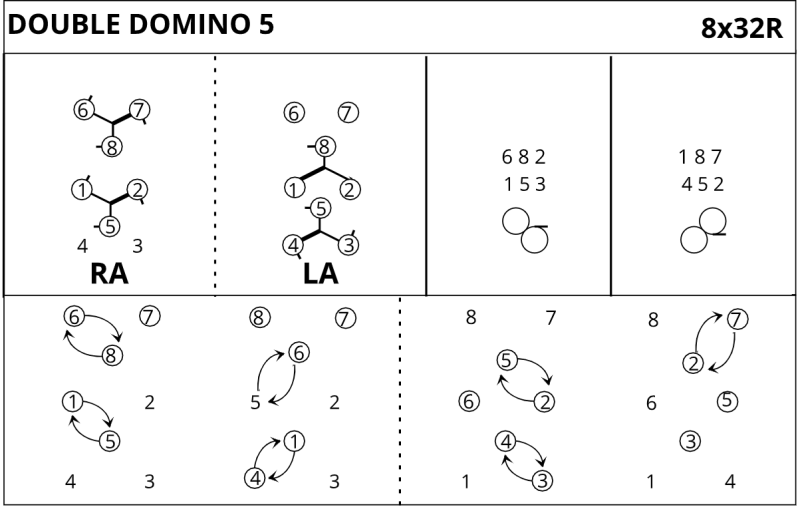
Now a challenge – Double Domino 5 – add 3 more dancers to the “ladies side” of the set and the dancers in positions 1 and 2 also dance as 4 and 3 in the other part of the set. I came across this in a JAM class I stooged for one Easter School, the dance fell apart on about the 6th time through! The dance has not been published anywhere but I’ve managed to cobble together a diagram for those who like the “Pilling” diagrams, with acknowledgement of Keith Rose whose diagrams I have “copied and paste” to make this poor imitation.

And the instructions:

Bars 1 to 4         1+2+5 also 6+7+8 RH across

Bars 5 to 8         3+4+5 also 1+2+8 LH across

Bars 9 to 16       1+5+3 also 6+8+2 RSh reel of 3

Bars 17 to 24    4+5+2 also 1+8+7 LSh reel of 3

Bars 25 to 26    1+5 also 6+8 chg pl RSh

Bars 27 to 28    4+1 also 5+6 chg pl RSh

Bars 29 to 30    3+4 also 2+5 chg pl RSh

Bars 31 to 32    2+7 (only) chg pl RSh

The dancers in positions 1 and 2 have to keep their wits about them and be ready to dance the LH across as well as RH across and both the reels and dancers 2 and 5 have to be prepared to take part in the change of positions in both parts of the set.

Programme for Wednesday 8th April

Our second virtual club night:

Warm-up Amazing Grace we will keep doing this, it’ll be great to all do it together when we meet again.

Dance. New Year Jig is a dance we did last year a few times. It is a popular easier dance on evening programmes. It was devised by Maureen Robson of Wellington and published in RSCDS Book 51. The first 8 bars only have 1st couple moving – that makes it easy for a couple that has finished their 2nd time to step down and the 4th couple to step up and be 3rd couple.

Here it is in diagram:

And the instructions:

Bars 1 to 8        1st dance figures of 8 on their own side, passing 2nd couple by right shoulder to begin, 1st lady finishes facing out

Bars 9 to 16     1st, 2nd and 3rd couples dance reels of 3 on the side (1st and 2nd couples pass right shoulder to begin), 1st lady finishes facing out

Bars 17 to 24   1st lady followed by 1st man cast behind 2nd lady, dances up between 2nd couple, behind 2nd man and crosses the set to 2nd lady’s place (2nd couple step up on bars 5 and 6), 1st lady finishes facing out

Bars 25 to 28   1st and 3rd couple dance right hands across, 1st and 2nd couples dance left hands across

Bars 29 to 32   1st and 2nd couple dance left hands across, 1st lady finishes facing out ready to repeat

Here is a video of it being danced New Year Jig. This is an instructional video done by RSCDS and shows the dance danced twice through by one couple (and then shows it again from a different angle).

Some points to note:

  • 1st couple phrase their dancing so that they never stop – each formation is completed in just the bars of music for it so that they flow smoothly into the next formation
  • The reels – all 3 couples start dancing from the beginning – the 3rd couple dance towards the right (they don’t wait for the other 2 couples to pass before joining in)
  • Look at how all couples keep eye contact with their partners at the ends of the reels (turning their heads slightly)

Just a dance to watch – danced as a demonstration at a RSCDS New Zealand Branch Summer School in Dunedin some years ago – Those Russians

Formation – Circle hands round and back. A deceptively simple formation, there really is a lot to think about. It starts (and finishes) on the side lines (straight lines) but is danced in a circle so the dancers dance on a curve to make the circle and danced out on a curve at the end into the sidelines. The feet move first and the hands come up to join the dancers as the circle is formed (no lunging). Hands are released top and bottom at the end of bar 6 to dance out to the sides. The change of direction at the end of bar 4 is anticipated. The whole formation is danced on the balls of the feet alternating 2nd and 1st positions. This video of Farewell to Balfour Road (Book 52) Farewell to Balfour Road shows hands round done beautifully, it is the first 8 bars of the dance and since the dance is a canon it occurs again in bars 17 to 24, 33 to 40 and so on.

Programme for Wednesday 1st April

Although we are unable to meet physically, we can still have a virtual club night:

Warm-up Amazing Grace

Dance. We have danced Corn Rigs in recent weeks. There is a wonderful short 1957 film called “Scotland Dances”, narrated by Gordon Jackson that can be viewed at the National Library of Scotland website (link below). The film includes a shot of Corn Rigs being danced in a corn field amongst the stooks.

Scotland Dances

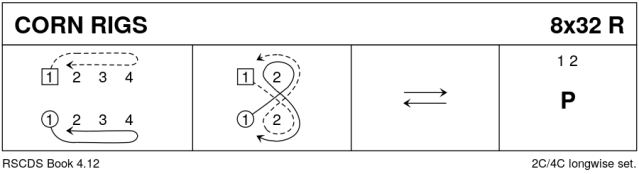
Here is the dance in diagram form

And the instructions:

Bars 1 to 8        1st couple cast off and dance behind own line for 4 bars, turn inwards and dance up to original places

Bars 9 to 16     1st couple dance a figure of eight around 2nd couple

Bars 17 to 24   1st couple lead down the middle and up to finish in the middle of the set facing their partner with both hands joined, 2nd couple step in (on bar24, also join both hands)

Bars 25 to 32   1st and 2nd couples dance a pousette

A few points to note;

  • 1st couple turn inwards (towards each other) at the end of bar 4 to dance back up
  • 1st couple need to be past 2nd couple so they can step in during bar 24
  • The pousette is a square formation with good sharp corners
  • Each 8 bars of the dance should fully use the 8 bars of music and be completed in it, the formations should flow smoothly from one to the next so that for example, 1st couple arrive back in their places at the end of bar 8 so that they can dance the figure for 8 without stopping

Here is a reasonable video of it being danced. Corn Rigs

To see any formations being danced well, have a look at the Lower Hutt SCD instruction videos: Lower Hutt teaching videos

Dance it through in your head – or on your own walk it through

Formation – Promenade. Last time we met I mentioned a rather good demonstration of a 3 couple promenade in the dance Fidget. Here is a link to the video. The end of the promenade is modified for the 1st and 2nd couples who then dance a pousette (the end of which is modified to lead into Double Triangles). Fidget


A great Summer School at Cambridge

Quentin, Ruth and Emily had a great time at Summer School, inspiring teaching from Mervyn Short, Jamie Berg and Christine Freeman, wonderful music from Ian T Muir, James Gray, Iain Mackenzie and others, lovely evening dances including Hogmanay and the President’s Ball and lots of friendly dancers.